A global hyperscaler needed a repeatable way to identify laptops across its US operations. The program moved RFID application upstream: device suppliers or technology resellers would apply the serialized label before delivery, rather than adding identification after devices reached facilities or were entered into the company’s IT asset inventory.
The program team selected Metal Skin® Delta for its compact footprint, flexible 0.4 mm profile and reliable UHF performance where the selected placement area included metal. Xerafy retained that proven RF platform while increasing printable area, strengthening adhesion for a four-year device lifecycle, qualifying a controlled read zone, and defining the encoding, roll configuration, packaging and QA needed for staged six-figure production.
Key Considerations for Enterprise ITAM Programs
- For source tagging, product fit includes printing, encoding, packaging, QA, and the applying party’s workflow, not only RF performance.
- A high-performing on-metal label still needs an upper read boundary. Reliable intended reads and controlled cross-reads must be qualified together.
- A proven standard antenna platform can shorten custom development when the main changes concern printable area, attachment, and data handling.
- The best attachment decision is sometimes a material change, not a more complex mechanical design.
This case study documents Xerafy’s engineering work on an enterprise laptop source-tagging program, from label customization and testing through production qualification. Customer and partner names and sensitive project details have been omitted to protect confidentiality.
The Challenge: Give Each Laptop an RFID Identity Before It Reaches US Operations
The customer wanted laptops to arrive with a persistent RFID identity already applied. This moved labeling upstream. Instead of tagging devices after receipt, device suppliers or technology resellers would apply the label before delivery.
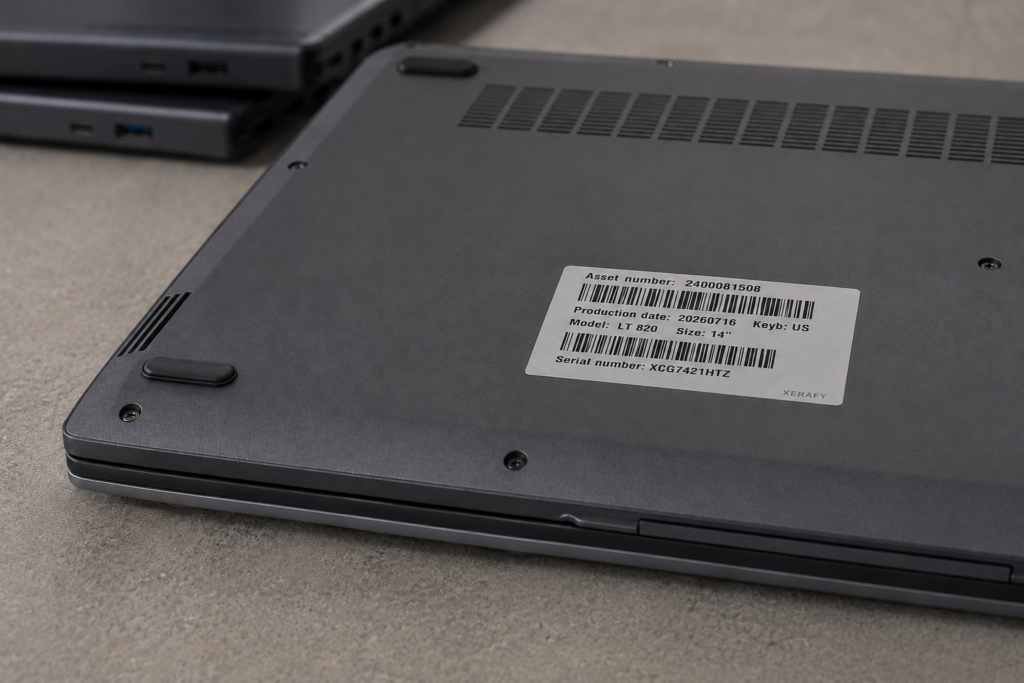
That changed the product requirements. The label had to fit the selected placement area on a mixed-material laptop, carry the required visible and encoded data, withstand routine handling, and run through a repeatable print-and-encode process. Roll quantity, orientation, serialization, packaging and QA also had to work for the party applying the labels.
Why Metal Skin® Delta Fit Enterprise Laptop Tagging
Laptop housings combine metals, polymers, coatings and internal components, so RFID performance depends on the actual placement area rather than the device category alone. Metal-containing surfaces can detune conventional RFID labels, while each mixed-material construction still requires placement and read-zone validation.
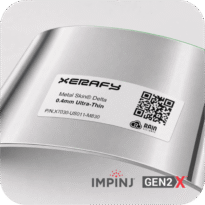
Metal Skin® Delta combines an on-metal UHF antenna with a flexible 0.4 mm construction. Its slim profile sits close to the device and conforms more readily to the selected placement area, reducing protrusion, friction, abrasion and interference during daily handling. Xerafy developed a larger custom format while retaining that profile and the proven Delta antenna architecture.
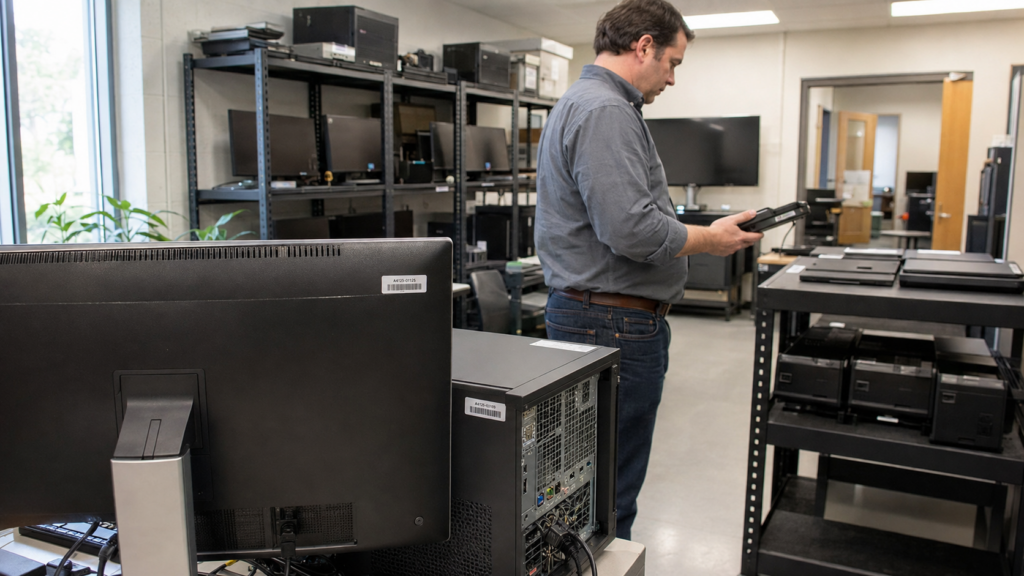
The same selection logic extends to other enterprise IT assets with suitable placement areas, including tablets, monitors, compact PCs, docking stations, switches, storage devices and some handheld equipment. Surface construction, available space, adhesion, device density and the required read zone must still be validated for each asset type. The custom Delta performed almost too well. Qualification shifted from maximizing range to engineering a controlled read zone.
Five Requirements Shaped the Custom Delta
1. More printable area without more thickness
The larger custom format increased the usable print face while preserving the flexible 0.4 mm construction. It met the visible and variable-data requirement while maintaining a close, low-friction fit on the laptop.
2. Adhesion designed around a four-year device lifecycle
The four-year attachment requirement included repeated handling, transport and contact inside laptop bags, where exposed label edges can lift or snag. The team considered tapered edges, but Delta’s ultra-thin manufacturing method could not support that geometry. Xerafy retained the flat construction and selected a stronger 3M adhesive, meeting the lifecycle requirement without redesigning the antenna platform.
3. Controlled EPC identity and serialization
The label needed a persistent identity that could be reproduced across production orders. Xerafy supported the EPC structure, serialization and encoding requirements so each production batch followed the same data rules.
4. A usable read zone, not simply maximum read range
Testing confirmed strong on-metal performance from the larger Delta format and characterized reads from nearby laptops. Qualification therefore covered both reliable intended reads and an upper boundary for unwanted reads, as reading without spillover mattered more than maximizing range.
The team retained the Delta antenna platform and addressed the usable read zone through system qualification.
5. Production configuration for upstream application
The program required more than blank labels. Encoded quantities, roll configuration, smaller packs for initial implementation, packaging, QA ownership and staged deliveries were defined before volume supply. These were product requirements because they determined whether the labels could be applied consistently upstream.
Metal Skin® Delta already provided reliable UHF performance on the selected placement area and a flexible 0.4 mm profile. The custom work focused on making that platform production-ready for the customer’s print, adhesion, encoding and supply requirements.
Engineering the Label for Upstream Application
The asset owner defined the identity and lifecycle requirements. Device suppliers or technology resellers were expected to apply the labels before delivery. The reader environment then had to identify the intended laptop without capturing nearby devices, while the serialized EPC connected the physical asset to the customer’s records.
Xerafy owned the RFID tagging layer: adapting Metal Skin® Delta, supporting RF and attachment qualification, defining encoding and serialization requirements, and supplying the label in a repeatable production format. Reader infrastructure, software and the wider IT asset workflow remained with the customer and its implementation partners.
Print durability is a property of the complete media system, not the label alone. For the custom Delta, qualification considered the face stock together with ribbon selection, printer heat and speed, handling conditions and rub-test criteria. Source-tagging readiness requires both RF performance and a repeatable print-and-encode process. On Zebra printers, print speed, darkness and RFID calibration settings can vary by printer model and label format, so the setup must be checked before production.
The Outcome: A Deployment-Ready Delta at Six-Figure Scale
The custom flexible 0.4 mm M830 label moved through tooling, encoding preparation, QA, packaging and staged supply for a six-figure laptop source-tagging program. It retained the Delta antenna platform and slim construction that drove the original selection.
Applying the identifier upstream prepared each laptop for inventory, audit, assignment and lifecycle records from its first receipt into the enterprise IT environment.
The project provides valuable learnings for program managers: start with a proven RF platform, change only what the application requires, and qualify the label as it will actually be printed, encoded, applied and read.
Deployment and Validation Lessons for Engineers
- Start with the actual device surface, placement area, handling pattern, and acceptable profile.
- Confirm visible data, variable fields, and barcode requirements before fixing the label dimensions.
- Test edge lift, snagging, abrasion, and adhesive performance against the expected device lifecycle.
- Qualify the complete print-media stack: face stock, printer, ribbon, heat, speed, handling, and rub-test criteria.
- Define EPC ownership, prefix, serialization, reprint control, and QA before volume production.
- Specify roll quantity, orientation, core, packaging, and records for the party applying the labels.
- Test intended reads and cross-reads in the real device density and reader geometry.
- Treat supplier onboarding and repeatability as engineering requirements, not post-selection logistics.
Evaluate Metal Skin® for Enterprise IT Asset Tracking
For laptops and adjacent enterprise IT assets, selection should start with the actual surface construction, available placement and print area, required profile and flexibility, attachment method, device density, target read zone and the workflow of the party applying the label.
Discuss an enterprise IT asset tagging program with Xerafy engineers.
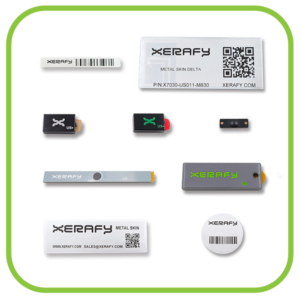
Xerafy develops field-proven RFID tags and labels for tracking assets in demanding industrial and enterprise environments. Its portfolio combines application-specific RFID engineering with products available for evaluation and deployment worldwide.
For requirements beyond standard products, Xerafy provides Custom RFID Tag services spanning printing, encoding, serialization and production configuration through to custom product engineering.