Email Your Representative
For Industrial Assets, Products and Packaging
Choose the right RFID label, inlay, printing, encoding, or service-bureau path for your asset, surface, workflow, and deployment scale
RFID labeling is the process of selecting, printing, encoding, and applying RFID labels or inlays to products, packaging, inventory, and industrial assets.
The right solution depends on the asset surface, read environment, adhesive, label construction, printing and encoding workflow, deployment volume, and validation requirements. A label that works on cardboard packaging may fail on metal, curved surfaces, sterilized products, high-temperature processes, or rugged industrial assets.
Use this guide to route your project to the right Xerafy labeling path:
| RFID labeling need | Recommended path | Selection trigger |
|---|---|---|
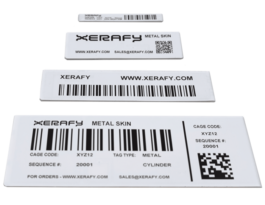
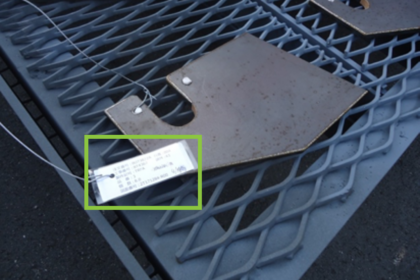
| Printable RFID labels for metal assets, IT equipment, tools, WIP parts, machinery, or mixed-material inventory | View printable on-metal RFID labels![]() | The label needs printable face stock, on-metal RFID performance, industrial adhesive, and asset-level identification |
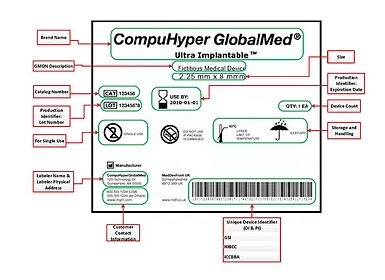
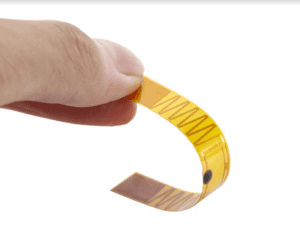
| Specialty RFID labels or inlays for products, packaging, medical devices, sterilization, high-temperature processes, UDI, DPP, mandates, or lifecycle identity | View specialty smart labels and inlays![]() | The project needs engineered label construction, conversion, encoding, serialization, process validation, or product/package-level identity |
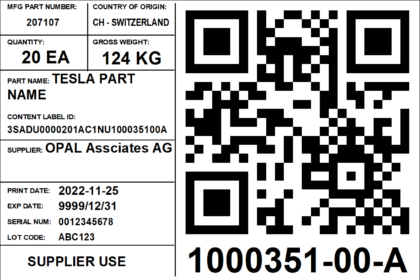
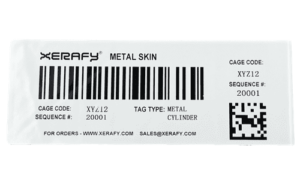
| Printed, encoded, serialized, QR/barcode-marked, logo-marked, or rollout-ready RFID labels | Ask about ready-to-use RFID labels![]() | The labels need to arrive ready for deployment, with visible and machine-readable identifiers already applied |
| Harsh environments, impact, washdown, tools, scaffolding, surgical instruments, hoses, oilfield assets, or long lifecycle tracking | Rugged RFID Tags / Engineering Review | A label may fail because the asset, environment, mounting method, or lifecycle requires a hard tag |

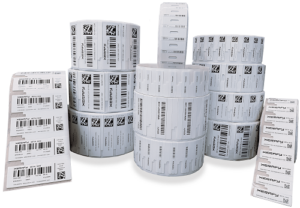
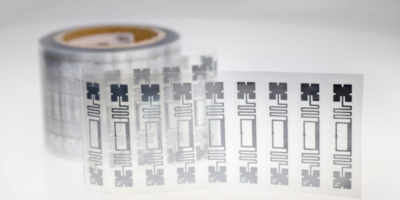
An RFID label combines a printable label construction with an RFID inlay, including a chip, antenna, substrate, and face stock.
It can carry visible information such as text, barcodes, QR codes, logos, or serial numbers, while also storing machine-readable RFID data for wireless identification.
RFID labels are typically supplied in rolls for printing and encoding. Wet inlays include adhesive and a release liner for conversion or application, while dry inlays are supplied without adhesive for embedding or further conversion.
RFID labeling is used to identify products, packaging, inventory, tools, equipment, machinery, returnable assets, and industrial components without line-of-sight scanning.
Common uses include inventory control, asset tracking, product serialization, supply chain traceability, packaging verification, work-in-process tracking, and mandate-driven identification.
The right RFID labeling path depends on the item being labeled, the surface material, the read environment, the print-and-encode workflow, and the expected lifecycle of the asset or product.
The asset surface is one of the main drivers of RFID label selection.
Metal can detune standard RFID labels and usually requires an on-metal RFID label. Liquids and high-water-content materials can absorb RF energy and reduce read range. Some plastics, glass, composites, coatings, and curved surfaces can also affect adhesive performance, read consistency, and label durability.
Use printable on-metal RFID labels for metal assets, specialty labels or inlays for engineered product and packaging requirements, and rugged RFID tags when the surface, environment, or lifecycle is too demanding for a label.
If the asset surface, adhesive, or read environment is uncertain, validate with samples before rollout.
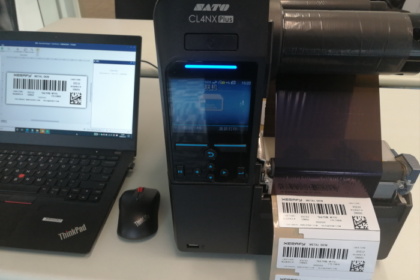
Yes. Printable RFID labels can be printed and encoded with compatible industrial RFID printers, including common Zebra, SATO, and TSC workflows.
On-metal printable RFID labels are thicker than standard labels, making industrial RFID printers the preferred choice for custom printing:
+ ZEBRA ZT411R
+ SATO CL4NX Plus
+ TSC T6000e
Industrial RFID label workflows typically use thermal transfer printing, where a ribbon transfers durable print onto the label face stock.
For high-volume or rollout-ready programs, a service bureau can supply labels that are already printed, encoded, serialized, QR/barcode marked, logo marked, and quality checked before deployment.
RFID labels are read with RAIN RFID readers, using handheld, fixed, portal, tunnel, or mobile reader setups depending on the workflow.
Read performance depends on the label, asset surface, reader power, antenna placement, read zone design, item orientation, and nearby materials such as metal or liquids.
For reader selection, use the Xerafy RFID Readers Guide or ask Xerafy engineers to review the application.
RFID serialization assigns a unique digital identity to each labeled item.
In product and inventory workflows, this may include encoding EPC memory (Electronic Product Code) with a unique identifier such as an SGTIN (Serialized Global Trade Item Number), while also printing visible information such as a barcode, QR code, serial number, or human-readable ID.
Serialization helps prevent duplicate labels, RFID clutter, and system-level identification errors. Before rollout, define the data structure, encoding rules, print format, verification process, and ownership of label records.
Xerafy can support serialization through engineering review, printing, encoding, and service-bureau workflows.
Yes, some RFID labeling projects must support application-specific standards, mandates, or data requirements.
Examples include VDA workflows in automotive supply chains, UDI for medical devices, UID for military assets, retailer RFID mandates, and product-level serialization programs.
The RFID label alone does not create compliance. The label construction, printed information, encoded data, verification process, reader setup, and system records must all match the required workflow.
Xerafy engineers can help identify whether the right path is a standard RFID label, an engineered XSKIN label or inlay, a printable on-metal label, or a rugged RFID tag.
RFID label cost depends on the label construction, chip, antenna design, adhesive, face stock, durability requirements, printing, encoding, serialization, and order volume.
For industrial and product-level RFID labeling, the best cost benchmark is the cost of a working deployment: a label that fits the surface, can be printed and encoded reliably, reads consistently in the workflow, and supports the required data structure.
Xerafy engineers can help compare standard labels, printable on-metal labels, specialty labels, inlays, and service-bureau options to match the project requirements and deployment scale.
Use a hard RFID tag when the asset or environment is too demanding for a label.
This includes heavy impact, abrasion, washdown, outdoor exposure, high heat, autoclave cycles, tool tracking, scaffolding, hoses, surgical instruments, construction assets, or long lifecycle tracking.
In these cases, a hard or rugged tag can reduce replacement risk, poor reads, and operational exceptions compared with a lower-cost label.