Fleets of waste management bins equipped with RFID help municipalities and utilities improve the operational efficiency of solid waste collection and recycling.

Because of the high wear and tear involved with everyday operation, rugged RFID components are required to equip the fleets of bins and vehicles in the field while minimizing maintenance in the shop.
RFID tags, also known as transponders, are attached to bins and carts and are available in versions designed for metal and plastic containers. Shock, impact, water, UV, temperature, and chemical resistance are all standard features of rugged RFID tags. Similar tagging solutions are available to waste bin and container manufacturers looking at enabling contactless identification and tracking for their products.
RFID readers are installed in every collection vehicle and are strategically placed near the lifting arm. This RFID waste management setup enables data to be automatically gathered each time a bin is handled, allowing waste collection capacity to be managed in real-time and driving quality of service across expanding collection networks.
The RFID waste management software is another key component of the system, with organizations having the choice of developing their own solutions or deploying solutions from specialist system suppliers.

Armorers and police equipment teams need to know which weapons are in storage, which have been issued, and whether officers have the equipment they need before going on duty. Passive UHF RFID identifies tagged firearms and associated equipment without batteries or individual line-of-sight scans.
Weapon tracking systems combine tags, handheld or fixed readers, and software to support:
Armory inventory: Count weapons in storage and reconcile detected items against inventory records.
Issue and return: Associate weapons with officer IDs to record who received each item and when it was returned.
Patrol equipment checks: Verify weapons, radios and other assigned equipment before each shift, reducing manual serial-number checks and identifying missing items before officers leave for duty.
Xerafy supplies the RFID tags and supports product selection, attachment and encoding. Solution providers connect those identifiers to inventory, custody and exception records.
RFID tags for weapons and equipment
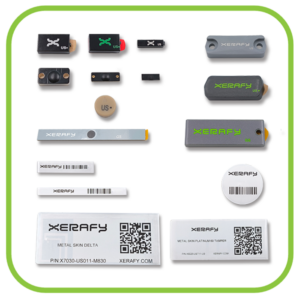
The PICO series and XS series provide compact tagging options for firearms and associated equipment. Selection depends on the mounting surface, available space, service exposure and intended read point.
Download the Xerafy Weapon Tagging Guide for practical guidance on tag selection, placement and attachment, with installation examples to support your project.
Considering RFID for your weapons or armory equipment? Contact Xerafy Engineering for tag recommendations, samples and pricing.
Tower monitoring leverages RFID technology to track and control cellular, television, and radio assets in the field, in remote geographic locations.

Telecommunications firms and tower operators depend on equipment in the field to maintain their networks and day-to-day operations. Teams on the groundwork with a plethora of vendors and service providers, each of which operates in its own silo, with its own infrastructure, systems, and processes.
A unified asset identifier or a centralized asset management system is crucial for operational efficiency and competitiveness in a market where tower uptime and service quality are critical differentiators. RFID tags and sensors help enforce unique item-level identifiers to deliver real-time visibility into the health and status of remote tower sites and their connected assets.
RFID monitoring helps Smart Cities manage and maintain their infrastructure.

Smart Cities provide wide-ranging examples of applications of RFID monitoring. Developing a Smart Grid, for instance, begins with the integration of intelligence into legacy infrastructure, which Xerafy RFID enables. Field equipment such as switch boxes and thermal switches are frequently regarded as weak points. The use of Xerafy RFID Tags for unified identification and remote monitoring directly benefits substation equipment.