Manufacturing RFID pilots often prove the tags and readers before they prove the workflow. A tag can be read, but the team may not yet know whether that read confirms a movement, production step, inspection or exception, or which enterprise record should change.
Closing that gap requires the physical and digital layers to be designed together. The tag must fit the asset and survive the process. The read point must capture the intended event without unacceptable stray reads. The event layer must filter noise, add context and handle exceptions. The integration must then create or verify the correct ERP, MES or WMS transaction.
Drawing on the combined field experience of Xerafy and EasyLogic, this paper provides a practical method for mapping and validating that full stack before scaling across more assets, read points or sites.
This paper is for manufacturing and integration teams planning or scaling RFID for WIP, tooling, production assets and enterprise-system workflows.
Key Takeaways
- Start with the operational event that must be recorded, not the RFID hardware.
- Design tags, readers, event logic and enterprise integration as one workflow.
- Define how duplicate, stray and unexpected reads will be filtered or escalated.
- Validate both tag performance and the resulting ERP, MES or WMS transaction before scaling.
1. Define the Manufacturing Event Before the RFID System
“Track assets” is not a sufficient manufacturing RFID project requirement. The team must define the operational change it needs to capture, how an RFID read will confirm that change, and which enterprise record should update.
Requirements seen in Manufacturing RFID projects
- Track more than 10,000 moulding dies across defined production zones.
- Maintain identification through temperatures up to 200°C, moisture, coating, chemicals and repeated cleaning.
- Combine fixed readers and handheld readers for automated zone visibility, search and audit.
- Identify hooks, carriers, fixtures and workplates moving through production.
- Connect confirmed RFID events with ERP, MES or WMS records.
- Scale from validation samples to hundreds or thousands of production assets.
Before selecting the RFID architecture, answer one question: What happened, where did it happen, which read confirms it, and which ERP, MES or WMS record should change?
2. Why Successful RFID Pilots Still Fail to Scale
Many RFID projects begin with a simple goal: identify assets automatically. Tags are attached. Readers are installed. Antennas are positioned. Data begins to flow. The pilot may prove that tags can be read and that the technology works in controlled conditions. Then the harder stage begins.
A reader may detect thousands of reads. Some reads are useful. Some are duplicates. Some are stray reads. Some occur at the wrong moment. Some must be associated with a location, process step, operator, order, batch, shipment, or production status. Some should trigger a transaction. Others should be ignored.
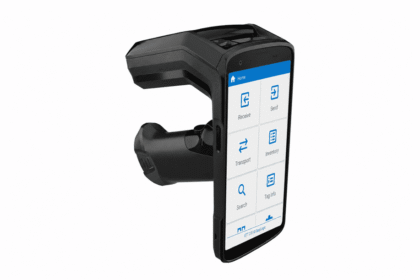
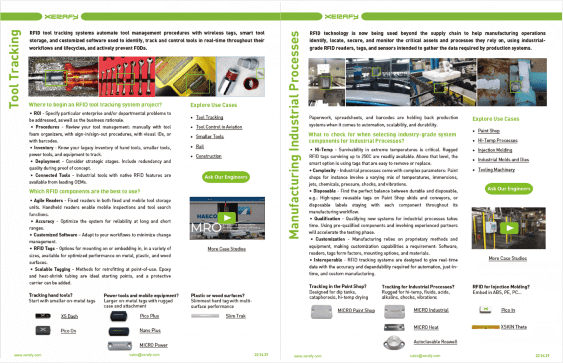
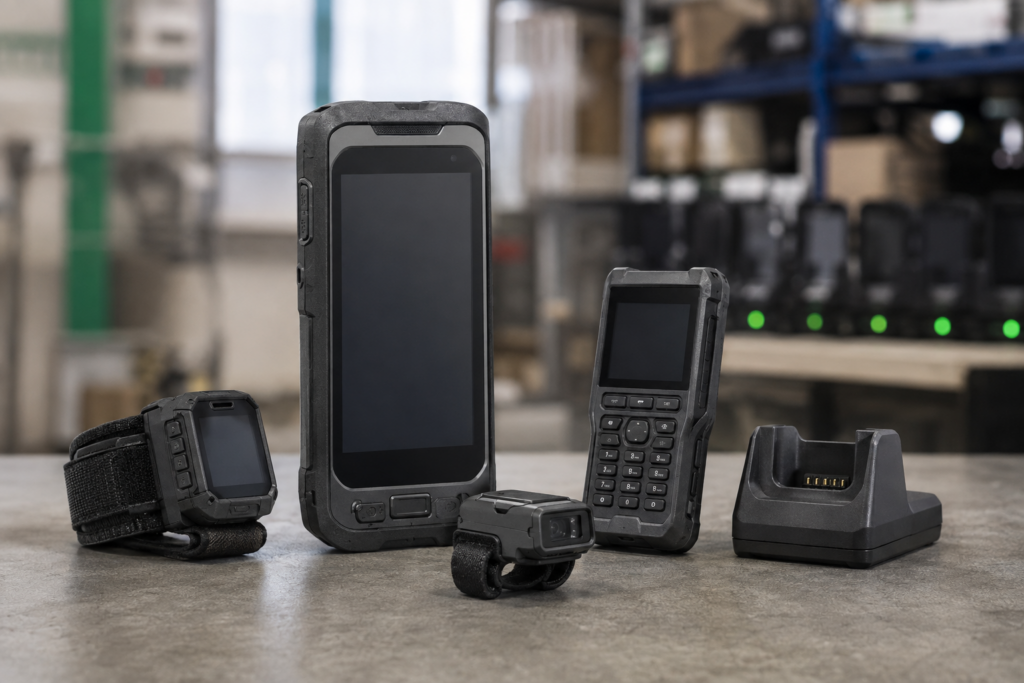
RFID Handheld Reader
At this point, the project moves from RFID performance to process design.
The practical questions become:
- Which reads represent meaningful manufacturing events?
- Which reads should be filtered out?
- Which read zone confirms receiving, staging, production, inspection, movement, or shipment?
- Which system should receive the event?
- How should inventory, location, production status, or quality records be updated?
- How should component-to-assembly relationships be created?
- What happens when a read conflicts with the expected system record?
- Who owns exceptions, data quality, device monitoring, and process changes?
Without answers to these questions, RFID data remains isolated from the systems responsible for manufacturing operations. The project may prove the hardware, but it does not yet prove the workflow.
3. The Event Layer Between RFID Readers and Enterprise Systems
An RFID reader reports that a tag was detected. An ERP, MES or WMS needs to know what operational change occurred and whether a record should be updated. These are not the same thing.
For example:
- Raw read: Tag 3017 was detected by Reader 4.
- Manufacturing event: Mould 3017 entered Production Zone 4 at 10:42; update its location in the ERP.
EasyLogic Track and Trace (ETT) provides the event and integration layer between RFID infrastructure and enterprise systems. It collects reader activity, removes duplicate or out-of-context reads, adds asset and process context, applies event rules and exchanges validated transactions with the relevant system.
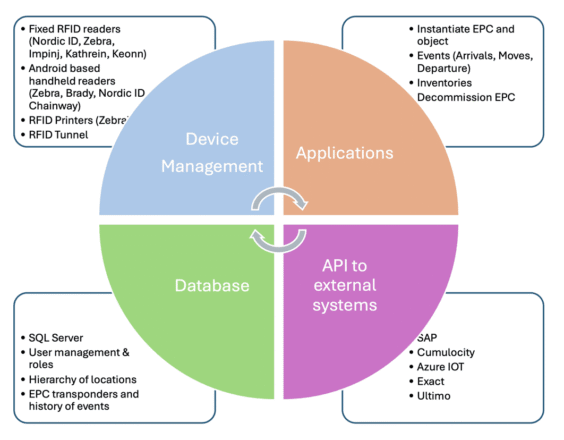
Easylogic Software Stack
| Stage | What happens |
|---|---|
| Read | A fixed or handheld reader detects an identified asset at a defined read point. |
| Filter | Duplicate, stray and out-of-context reads are removed. |
| Context | The asset, location, time, process step and applicable rule are added. |
| Event | ETT determines whether the read confirms a movement, process step, inspection or other operational change. |
| Exception | Conflicting or unexpected activity is held for review instead of creating an incorrect record. |
| Transaction | The validated event updates or verifies the corresponding ERP, MES or WMS record. |
This layer prevents enterprise systems from receiving every raw RFID detection as if it represented a valid operational event. It also provides a controlled point for managing read rules, exceptions and interfaces without embedding device-specific logic throughout the enterprise architecture.
The required event logic must be defined for each workflow. A valid event may require a specific reader, direction of travel, sequence of reads, time threshold or asset status. Until those rules and the resulting enterprise transaction are clear, the RFID system may generate data, but it has not yet established reliable manufacturing traceability.
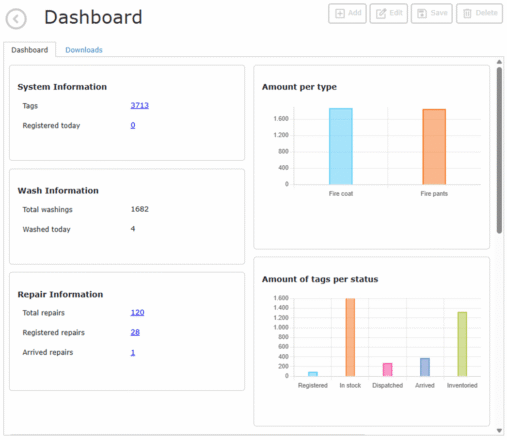
Example dashboard of an ETT system
4. The Full Manufacturing RFID Stack: Components and Responsibilities
A scalable manufacturing RFID deployment should be understood as a connected stack, not a single product purchase.
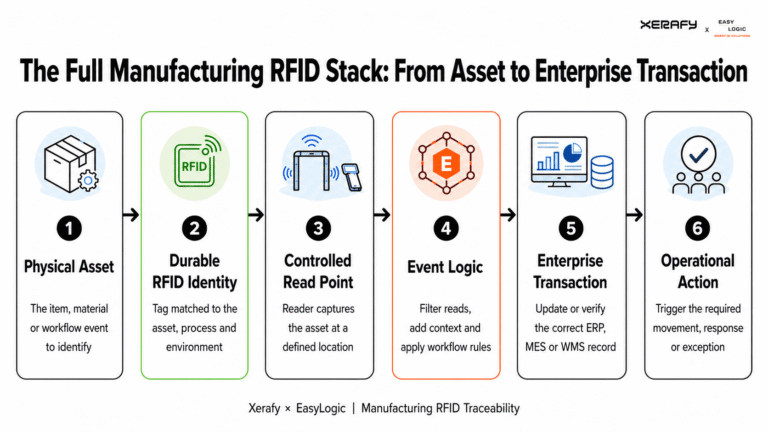
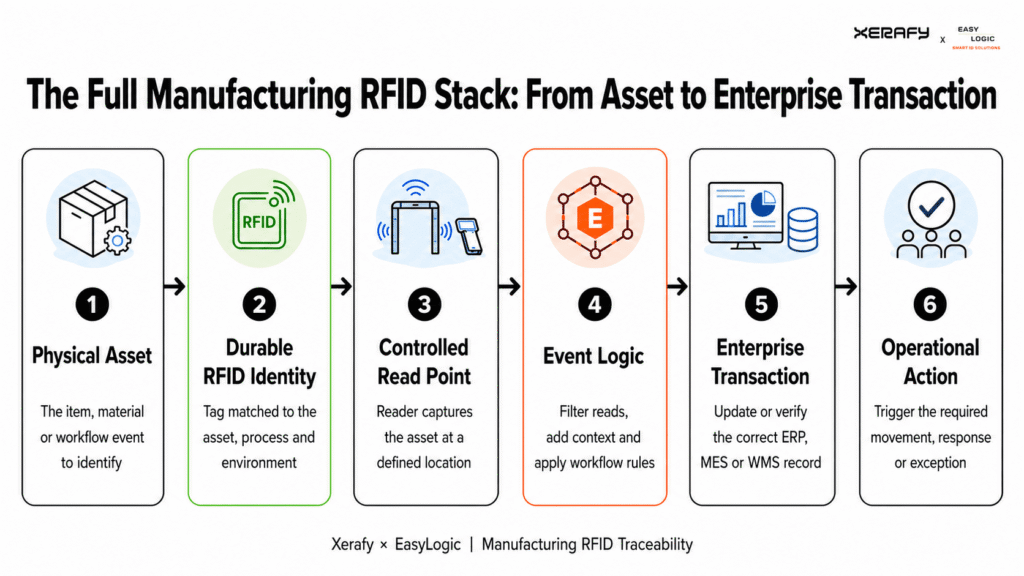
The manufacturing RFID stack connects a durable asset identity with controlled read points, event logic, enterprise transactions and operational action.
Xerafy provides durable item-level RFID identity for manufacturing assets. EasyLogic ETT connects reader infrastructure, event logic, and enterprise systems so physical manufacturing events can update operational records.
This model helps define the boundary between physical identification, reader infrastructure, middleware, enterprise-system integration, and operational action. It also prevents the project from being treated as only a tag-and-reader purchase.
Manufacturing RFID projects need clear ownership. “Complete solution” can mean different things to operations, IT, integrators, and vendors. The responsibility model should be agreed before scale-up.
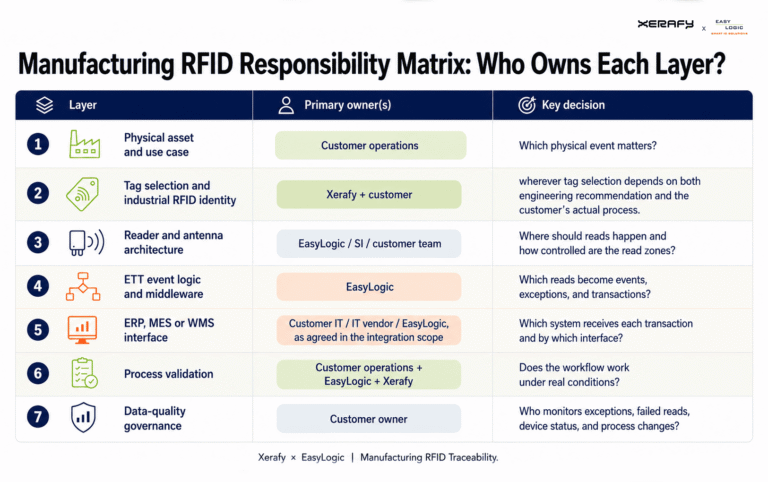
The matrix identifies the primary owner and key decision for each layer of a manufacturing RFID deployment, from physical-event definition and tag selection through integration, validation and data governance.
This boundary matters. It keeps the RFID stack realistic and prevents the deployment from being oversold as a plug-and-play component.
5. Manufacturing Workflows and the Events That Matter
A manufacturing workflow becomes traceable only when the physical event and the expected enterprise result are both defined. The same RFID read can produce different outcomes depending on where it occurs, what the asset represents and which event rule applies.
| Workflow | Physical event to capture | Enterprise result |
|---|---|---|
| WIP movement | Material, component or carrier enters or leaves a defined production zone. | Update location or production status in ERP or MES. |
| Tooling control | A mould, die, fixture or tool is issued, returned, moved or detected in the wrong zone. | Update availability and location, or create a missing-asset exception. |
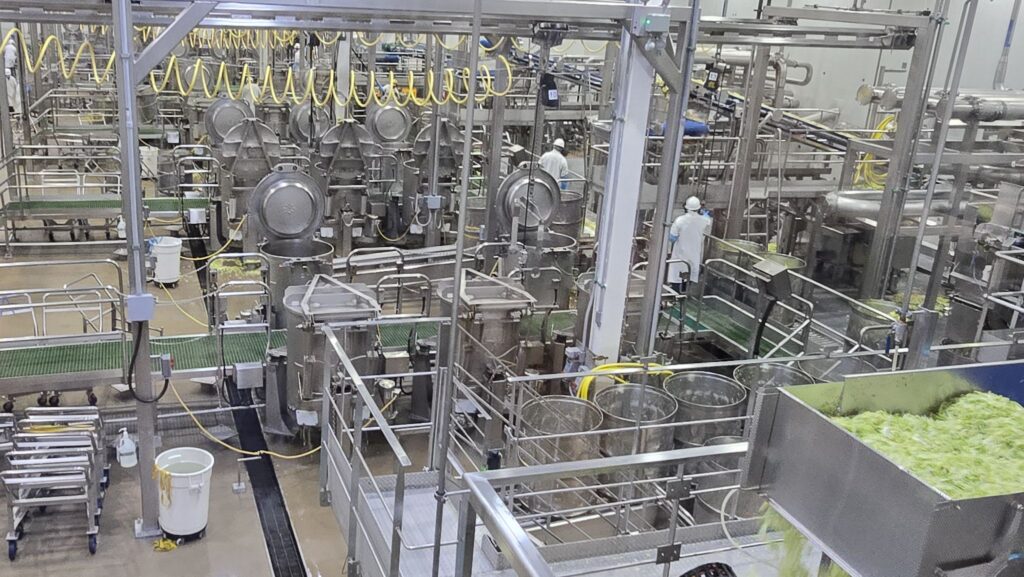
| Paint-line and high-temperature tracking | A hook, hanger, skid or carrier passes a defined process checkpoint. | Record the completed process stage and update its production history. |
| Receiving and internal logistics | Tagged material crosses a receiving, staging, replenishment or shipping point. | Create or verify the corresponding receipt, stock movement, replenishment or shipment transaction. |
| Product genealogy | A component or batch is associated with an assembly, work order or inspection step. | Update the BOM, batch, quality or traceability record. |
The capture method follows the event. Fixed readers and portals support controlled checkpoints and continuous zone monitoring. Handheld readers support search, audit and exception handling. Printers and encoders create and associate the RFID identity at its source. In each case, the tag, antenna position, read-zone boundary and event rule must be validated as one workflow.
This paint-shop deployment case study shows this model in practice: tagged hangers pass 22 read points along a nearly 10-kilometre production line, and the confirmed events update WIP, stock and purchasing data in SAP.
6. Manufacturing RFID Event-Design Worksheet
A scalable deployment should define the event model before scale-up. The event model explains how a physical read becomes a business transaction.
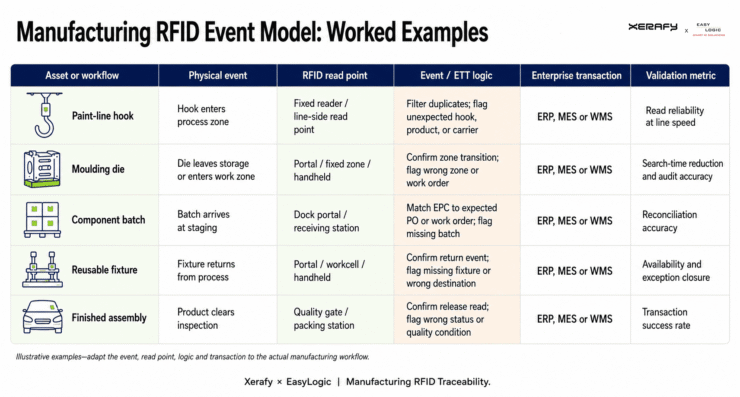
Worked examples showing how manufacturing assets and workflows map to physical events, RFID read points, event logic, enterprise transactions and validation metrics.
This worksheet should be adapted to each customer workflow. The important point is that the physical event, read point, ETT logic, exception handling, and enterprise transaction are designed together.
Map Your Manufacturing RFID Workflow – Share your asset, process conditions, required read points, enterprise system and deployment scale. Xerafy and EasyLogic can help identify the tag, infrastructure and event-integration requirements to validate: Review Your Manufacturing RFID Project
7. Match the RFID Tag to the Asset, Process and Read Environment
Event logic depends on reliable physical input. A tag that performs on the test bench but fails after mounting, heat, coating, washing or repeated handling will produce missing or misleading events.
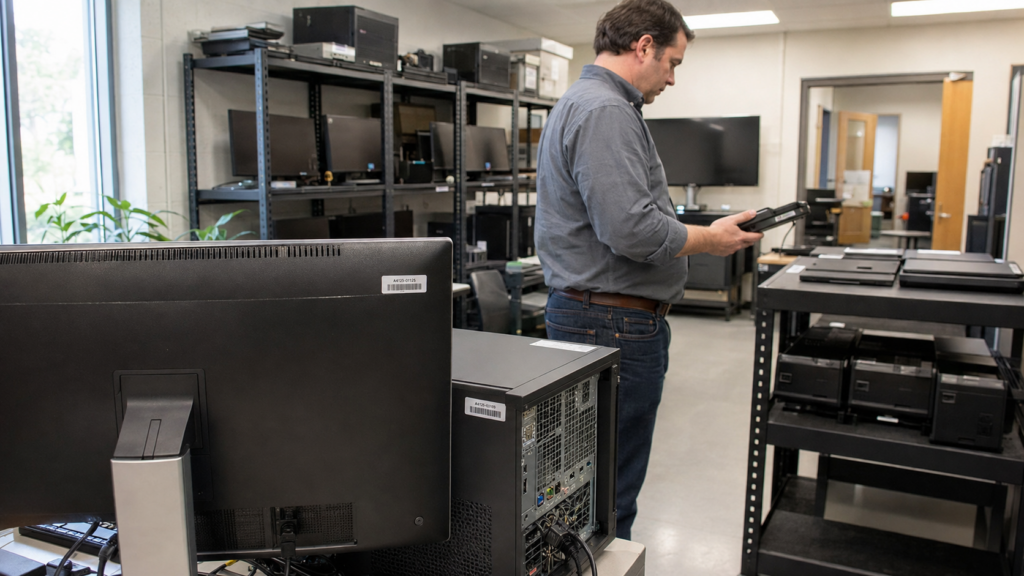
Start with the actual asset and process. Define the surface and geometry, available mounting and marking area, temperature and exposure time, chemicals or washing, attachment method, required read point and distance, asset orientation and density, and any printing, encoding or memory requirements.
| Primary constraint | Xerafy starting point | Validate before selection |
|---|---|---|
| High-temperature metal assets and repeated process exposure | MICRO Industrial or MICRO Paint Shop. MICRO Paint Shop is designed for paint environments requiring a silicone-free construction. | Peak and continuous temperature, exposure duration, number of cycles, chemicals, coating, cleaning and mounting position. |
| High-temperature printable identification where a hard tag is impractical | XSKIN Theta for products, components or process assets requiring a configurable printable label. | Surface, adhesive and label construction, temperature profile, printing and encoding workflow, and exposure cycles. |
| Small or embedded metal tooling | PICO In or XS Wedge, with other PICO or XS formats considered for surface mounting. | Available recess or mounting area, temperature, mechanical protection, installation method and required read range. |
| Low-profile printable identification on metal | Metal Skin® when the asset also needs a printed ID, barcode, QR code or other visible information. | Metal surface, curvature, available label area, abrasion, adhesive, printer compatibility and required read distance. |
| Rugged reusable metal production assets | MICRO Industrial or ROSWELL, depending on temperature, chemical and mechanical exposure. | Impact, vibration, water, chemicals, attachment strength, antenna orientation and repeated handling. |
| Plastic or wood RTIs, totes, bins and pallets | POD TRAK or a printable RFID label, depending on the required durability and deployment scale. | Asset material, stacking, tag orientation, mounting protection and performance at portals, forklifts or handheld read points. |
This matrix identifies a starting point, not a final tag selection. Test the shortlisted tag on the real asset, in its intended mounting position, through the actual process and with the production reader and antenna configuration. Confirm both that the intended event is captured and that nearby assets do not create false events.
8. Pilot-to-Scale Gate: Validation and Stop Conditions
A successful pilot must prove the complete workflow, not only that the tag can be read. Before scaling, validate the tag on the real asset and process, control the read zone, confirm the event logic, and verify that the correct ERP, MES or WMS transaction follows.
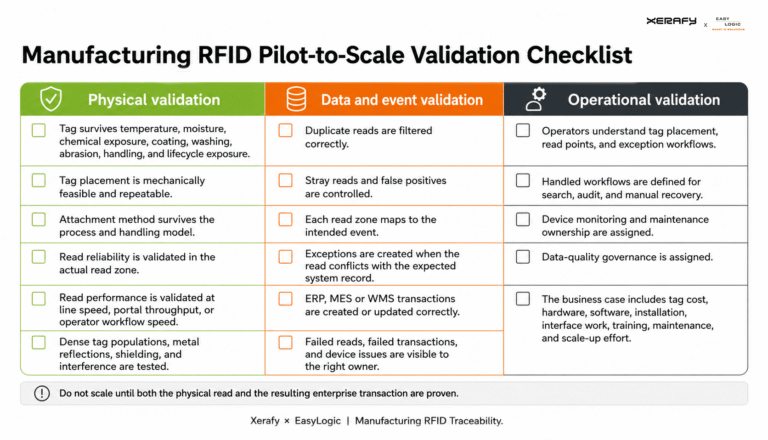
A manufacturing RFID pilot is ready to scale only after physical performance, event logic, enterprise transactions and operational ownership have been validated under real deployment conditions.
Stop Conditions: Do not scale the deployment while any of the following remains true:
- The requirement is still described only as “track assets.”
- The tag has not been tested on the real asset through the actual process.
- The read point cannot reliably distinguish the intended event from nearby or stray reads.
- The resulting ERP, MES or WMS transaction is undefined or unverified.
- Duplicate, conflicting or unexpected reads have no defined handling rule.
- Interfaces, exceptions or operational responses have no named owner.
- The business case considers tag price but not the full deployment and operating cost.
If any condition fails, return to the relevant layer of the event model and resolve it before expanding the number of assets, read points or sites.
From Reliable Reads to Trusted Manufacturing Transactions
The challenge facing manufacturers is no longer simply identifying assets. The harder challenge is creating a trusted connection between physical operations and enterprise systems.
RFID provides the ability to identify products, components, carriers, tools, and WIP without relying only on manual scanning or delayed updates. But identification alone does not create business value. Value appears when physical reads become structured events, and those events update the systems that manage production, inventory, quality, and logistics.
EasyLogic ETT bridges that gap by collecting, filtering, interpreting, and exchanging RFID events with enterprise systems. Xerafy supports the physical identification layer with industrial RFID tags and labels designed for demanding manufacturing conditions.
The practical next step is not to ask whether RFID can read a tag. The next step is to define the manufacturing events that matter, validate the physical read environment, and design the software layer that turns those reads into useful business records.
Xerafy designs and manufactures industrial RAIN RFID tags, smart RAIN RFID labels, and application-specific tagging solutions for asset tracking, inventory management, and automation in demanding environments.
Its portfolio includes rugged RFID tags, printable on-metal labels, embedded RFID tags, and specialized RAIN RFID labels for demanding workflows, including manufacturing, logistics, healthcare, oil and gas, aerospace, data centers, and textiles.
Xerafy works with system integrators, technology partners, converters, and global enterprises to help digitize physical assets with reliable RAIN RFID performance in real-world conditions.