Gamma irradiation sterilization is widely used for medical devices, procedure kits, consumables and pharmaceutical packaging. An RFID label used in these workflows must preserve its physical condition, encoded data and required read performance after the defined radiation exposure, while remaining compatible with the final product, packaging and production process.
XSKIN Gamma gives medical device manufacturers, pharmaceutical and packaging teams, sterilization providers and converters a specialty RAIN RFID platform for gamma and e-beam applications. Available in label and inlay formats, it can support printing, encoding, serialization, packaging integration and high-volume converting requirements.
Xerafy helps teams define the radiation exposure, label construction, substrate, encoded data, read environment and acceptance criteria before qualification and scale-up. This white paper explains the engineering decisions involved in that process. Applications involving autoclave, EtO, disinfection or other exposures are covered separately in our guide to sterilization-ready RFID.
1. Using RFID for UDI Identification Through Gamma Sterilization
UDI requirements identify medical devices from manufacturing through distribution and use.
The applicable rules depend on the device, market and responsible labeler. For example, the FDA UDI system generally requires covered device labels and packages to carry a UDI in human- and machine-readable form, with device information submitted to GUDID. Other markets maintain their own requirements, as outlined in our overview of global UDI requirements.
RFID can add a non-line-of-sight, machine-readable identity to the manufacturer’s UDI labeling and traceability system. Depending on the data architecture, the RFID chip can carry a serialized identifier or act as a key to records maintained in another system.
RFID can support:
- Serialized Identification: Assign a unique electronic identity to each device, kit or package.
- Production Traceability: Associate the identity with manufacturing, inspection and sterilization records.
- Automated Data Capture: Read individual or multiple labeled items without direct visual scanning.
- Inventory Visibility: Identify devices and packages across warehousing, distribution and downstream healthcare workflows.
- Data Availability: Use EPC and, where required, user memory for defined product or process information.
Before encoding, the manufacturer should define:
- The UDI or serialized data to be carried on the RFID chip.
- Which information remains in the enterprise database rather than on the tag.
- EPC and user-memory allocation, encoding and locking rules.
- Human-readable and barcode information required on the finished label.
- Read and data-integrity acceptance criteria after gamma irradiation.
RFID therefore provides an additional validated data carrier within the overall UDI program. The complete implementation also includes the applicable labeling rules, issuing-agency standards, regulatory submissions, production controls and manufacturer validation.
2. Engineering an RFID Label for Gamma Irradiation
Gamma irradiation can affect every layer of an RFID label. Qualification must therefore evaluate the complete construction rather than the RFID chip alone.
What Gamma Exposure Can Affect
- RFID Electronics: Chip operation, encoded data and memory integrity.
- RF Performance: Antenna behavior and read performance after irradiation.
- Label Materials: Face material, antenna substrate, protective layers and overall physical condition.
- Adhesion: Bond strength on the final device or packaging substrate.
- Printed Information: Human-readable text, barcodes, graphics and other printed data.
- Packaging Integration: Label position, product arrangement and the complete packaging configuration.
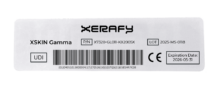
The XSKIN Gamma 73 x 20 is designed to withstand repeated Gamma and E-beam sterilization cycles, while supporting global RAIN RFID standards for international deployments.
XSKIN Gamma as the Starting Platform
XSKIN Gamma 73×20 is a global RAIN RFID label and inlay platform developed for gamma-irradiated medical devices, consumables and packaging. Its current technical datasheet specifies:
- Gamma Resistance: Rated for exposure up to 50 kGy.
- Global Frequency: 860–960 MHz for international RAIN RFID deployments.
- Memory: 128-bit EPC and 1,312-bit user memory for serialized identity and defined product or process data.
- Printable Format: A 73×20 mm label format for human-readable and machine-readable information.
- Converter-Ready Options: Finished label, wet-inlay and dry-inlay formats.
- Custom Configuration: Options for printing, encoding, adhesive, label size, inlay format and roll specifications.
For medical-device manufacturers and packaging teams, the standard platform is only the starting point. The final specification should define:
- Maximum dose and number of exposures.
- Cumulative radiation exposure where more than one cycle is expected.
- Final device or packaging substrate.
- Adhesive, face material and protective construction.
- Regional frequency and required read performance.
- EPC, user-memory, printing and encoding requirements.
- Label, wet-inlay or dry-inlay delivery format.
- Converting, application and production-inspection process.
The 50 kGy product rating should be qualified using the final construction, specified exposure and representative packaging. Acceptance criteria should cover physical condition, adhesion, encoded-data integrity and required RF performance before and after irradiation.
For projects requiring custom materials, roll specifications or inlay integration, Xerafy works with RFID label converters from platform selection through samples and production readiness.
3. How to Validate RFID in a Gamma Sterilization Workflow
ISO 11137-1:2025 defines requirements for developing, validating and routinely controlling radiation sterilization processes for medical devices. RFID label qualification should be incorporated into the manufacturer’s product, packaging and sterilization change-control process.
a. Define the Test Protocol
Document the conditions the RFID label must withstand:
- Minimum, target and maximum radiation dose.
- Number of expected exposures and cumulative dose.
- Device or package on which the label will be applied.
- Final label construction, adhesive, printing and encoded data.
- Packaging configuration, carrier arrangement and loading conditions.
- Sample quantity, controls and acceptance criteria.
Where multiple sterilization cycles are expected, test the cumulative exposure rather than assessing each cycle independently.
b. Establish the Pre-Irradiation Baseline
Before exposure, record:
- Visual condition and label dimensions.
- Adhesion to the representative substrate.
- Human-readable and barcode quality.
- EPC and user-memory contents.
- RF performance at the intended RFID read points.
- Any product-specific functional requirements.
The baseline provides the reference against which post-irradiation performance is assessed.
c. Irradiate Representative Samples
Use production-equivalent labels applied to the final device or packaging substrate. Samples should include the intended:
- Face material, adhesive and protective construction.
- Printing and encoding.
- Label position and orientation.
- Product and packaging configuration.
- Gamma dose and number of exposures.
Where relevant, include worst-case substrates, dose conditions and packaging positions.
d. Verify Performance After Exposure
Repeat the baseline checks after irradiation and any defined conditioning period. Acceptance criteria should cover:
- No unacceptable cracking, deformation, discoloration or delamination.
- Adhesion remaining within the project requirement.
- Human-readable and barcode information remaining usable.
- EPC and user-memory data remaining correct and readable.
- RF performance remaining within the required read zone.
- Physical and electronic performance meeting the defined product specification.
e. Assess the Production and Sterilization Process
The medical-device manufacturer and sterilization provider should determine whether introducing or changing the RFID label affects:
- The controlled product or packaging definition.
- Dose mapping or carrier-loading specifications.
- Performance Qualification or related validation documentation.
- Printing, encoding, application and inspection procedures.
- Device history, traceability and UDI data controls.
RFID label qualification complements the validated sterilization process by confirming that the label’s physical, data and RF functions remain within specification under the intended gamma exposure.
4. Where Gamma-Resistant RFID Creates Value
The strongest applications combine pre-sterilization serialization with reliable identification after gamma exposure. The RFID may be applied to the medical device, kit, primary package or another controlled packaging level according to the required workflow.
Medical Devices and Procedure Kits
Medical-device manufacturers can use gamma-resistant RFID to maintain a serialized identity across production, sterilization, distribution and downstream inventory processes. Applications include:
- Pre-Sterilization Serialization: Print and encode each label during device or kit production.
- Device and Kit Identification: Associate individual devices, components or procedure kits with their manufacturing records.
- Post-Sterilization Verification: Confirm that the expected identity and encoded data remain readable after gamma exposure.
- UDI Workflows: Connect RFID serialization with the manufacturer’s UDI labeling and data system.
- Inventory and Distribution: Capture device or package identities through warehousing, consignment and healthcare delivery.
- Global Deployment: Define a common frequency, memory structure and label specification for multiple markets and production sites.
The complete selection process, from the tagged item and label position through encoding and RF testing, is covered in our roadmap for tagging medical devices with RAIN RFID.
Sterile Packaging and Converter Integration
Packaging converters and medical-device packaging suppliers can integrate the RFID inlay into a finished label construction tailored to the product and sterilization process. The specification may include:
- Delivery Format: Dry inlay, wet inlay, finished label, roll or another production-ready format.
- Label Construction: Face material, adhesive, protective layers and final dimensions.
- Printing and Encoding: Human-readable information, barcodes, EPC serialization and user-memory data.
- Roll Configuration: Pitch, web width, core size, winding direction and production quantity.
- Packaging Integration: Application position, packaging substrate and compatibility with the sterilization workflow.
- Quality Control: Visual, encoding and RF inspection before labels enter device production.
The smart RFID packaging examples presented with AIPIA at CPHI illustrate how specialty label construction, sterilization exposure and packaging-level identification come together.
Pharmaceuticals, Consumables and Healthcare Supplies
Gamma-resistant RFID can also support serialized identification of pharmaceutical packaging, bioprocessing consumables, PPE and other healthcare supplies exposed to irradiation. Relevant workflows include:
- Packaging Identification: Assign a unique identity to packs, cartons, kits or controlled consumables.
- Production Traceability: Associate the RFID identity with batch, lot, sterilization and inspection records.
- Inventory Visibility: Capture multiple packaged items during warehousing and distribution.
- Controlled Handoffs: Record movement between manufacturers, sterilization providers, logistics partners and healthcare facilities.
- Data Integration: Connect each RFID identity with ERP, warehouse, traceability or healthcare inventory systems.
Within broader healthcare RFID workflows, the appropriate tagging level and label construction depend on the product, packaging, sterilization exposure and required read events.
5. Gamma and E-Beam Require Separate Qualification
Gamma irradiation and electron-beam sterilization both use ionizing radiation, but they expose the RFID label and packaged product under different process conditions. A qualification plan should account for:
- Radiation Source: Gamma photons and accelerated electrons interact differently with materials and electronics.
- Dose and Dose Rate: The same nominal dose may be delivered over a different exposure period and at a different dose rate.
- Penetration and Dose Distribution: Product density, packaging materials and item arrangement can affect the delivered exposure.
- Label Construction: The RFID electronics, antenna, face material, adhesive and printed information may respond differently to each method.
- Packaging Configuration: Product orientation, carton density and carrier loading should reflect the intended production process.
- Number of Exposures: Repeated or cumulative exposure should be included where the product lifecycle requires more than one cycle.
ISO 11137-3 provides guidance on dosimetry for the development, validation and routine control of radiation-sterilization processes.
Where a medical device or package may encounter both gamma and e-beam, qualify the final RFID construction separately under each intended process. Requirements that combine gamma with EtO or another exposure should similarly define and test each method and, where relevant, the complete process sequence.
How to Evaluate a Gamma-Resistant RFID Label
A useful evaluation starts with the medical device or package, its gamma exposure and the intended production workflow. Before selecting samples, define:
Application: The device, kit, consumable or packaging level that will carry the RFID identity.
Radiation Exposure: Maximum dose, number of exposures and cumulative dose where applicable.
Other Processes: E-beam, EtO, cleaning, temperature or other exposures the same construction must withstand.
Application Surface: Packaging material, device substrate, available dimensions and label position.
RFID Requirements: Regional frequency, read zone, item density, orientation, chip, EPC and user-memory requirements.
Printed Information: Human-readable text, barcodes, branding and variable data.
Delivery Format: Finished label, wet inlay, dry inlay, roll specifications or another converter-ready format.
Deployment Scale: Sample quantity, pilot volume, expected annual demand and target timing.
The evaluation can then progress through:
Selection of the standard XSKIN Gamma platform or a configured construction.
Printing, encoding and application to representative devices or packaging.
Baseline inspection, data verification and RF testing.
Exposure under the intended gamma conditions.
Post-exposure verification against the defined acceptance criteria.
Confirmation of the label construction, roll specification and production controls.
Evaluating RFID for gamma irradiation sterilization?
Start with the Healthcare RFID Test Pack to assess XSKIN Gamma alongside other healthcare tag and label formats.
Ask Xerafy’s engineers to review the product or packaging, radiation exposure, encoded data, converting requirements and intended read environment.
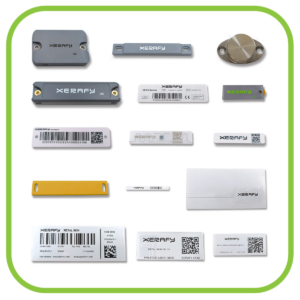
Xerafy designs and manufactures rugged RFID tags, specialty smart labels and custom RFID constructions for demanding identification and traceability workflows. XSKIN Gamma extends this portfolio to medical-device, pharmaceutical and packaging applications requiring a serialized identity through gamma or e-beam sterilization.
Xerafy works with medical-device manufacturers, packaging teams, label converters, service bureaus, sterilization providers and system integrators to define the label construction, inlay format, printing, encoding, memory, packaging integration and RF validation required for production. Its broader portfolio of RFID tags and labels is selected around the item, process exposure, data requirements and intended read environment.