Textile service operators are moving beyond traditional laundry chips and laundry tagging. The opportunity is shifting toward textile lifecycle identification: the ability to identify each garment, linen, uniform, or reusable textile asset at item level, across its full operating life.
This shift matters because the industry’s monetization challenge is not limited to garment purchase cost or RFID chip cost. The larger financial impact is often hidden in shrinkage, manual count and audit labor, billing disputes, excess inventory buffers, lifecycle uncertainty, and incomplete customer profitability data.
RFID gives each textile asset a unique digital identity. When that identity is captured at key workflow points such as collection, washing, sorting, packing, delivery, return, repair, and retirement, operators gain the operating data needed to manage textile assets as revenue-generating inventory, not just washable goods.
For CEOs and CFOs, RFID should be evaluated as a data investment, not only as a tagging expense. RFID data can support lifecycle cost control, margin visibility, scan-verified billing, fleet utilization, customer accountability, and more reliable analytics for textile service operations.
The ROI question is therefore broader than chip cost vs. garment cost. It is operating cost with item-level visibility vs. operating cost without it.
Why Textile Lifecycle Identification Requires a New Technology Investment Model
The textile services industry is moving through a new investment cycle.
For years, many operators ran with limited technology budgets. Operational control depended on experienced managers, manual counts, paper records, spreadsheets, barcode scans, and physical audits.
The next stage was IT investment: route accounting systems, laundry management software, dashboards, ERP integration, and customer portals.
That stage is necessary, but it is not enough.
Software can only report what the physical operation captures. If garments, linens, uniforms, workwear, and reusable textile assets still move through the operation without item-level event data, the system is still working from estimates, exceptions, and delayed reconciliation.
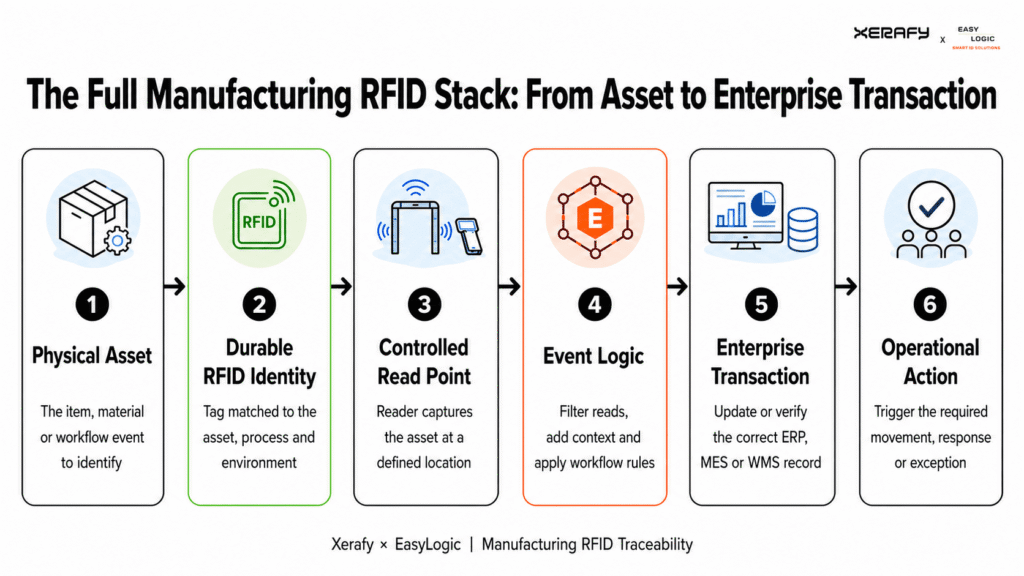
Textile lifecycle identification closes this gap. RFID connects physical textile movement to digital operating records. Every read event at a tunnel, portal, dock door, handheld reader, or processing point can create a timestamped data point that supports inventory control, billing, lifecycle management, customer reporting, and operational analysis.
This is why RFID should not be evaluated as a laundry chip cost alone. It should be evaluated as a data layer for measurable textile operations.
For CEOs and CFOs, the investment question is not only whether RFID tags can reduce manual work or prevent loss. The larger question is whether the operation can turn textile movement into reliable data for cost control, billing accuracy, margin visibility, customer accountability, and future analytics.
RFID Value Levers for Textile Service Operators
Textile service operators should evaluate RFID data across the operating levers that affect lifecycle profitability, not only through laundry chip or tag cost.
In commercial laundry, textile rental, uniform rental, and workwear rental operations, RFID ROI is commonly modeled across four value levers:
Fleet shrinkage: 8–12% fleet shrinkage used as a common baseline in RFID loss-modeling scenarios
Sort, count, and audit labor: 30%+ labor reduction used as a practical benchmark for automation impact in these workflows
Billing accuracy: 98–99% billing accuracy targeted in optimized scan-verified workflows
Payback period: 18–24 month payback used in modeled and documented RFID deployment scenarios
(These figures should be treated as directional benchmarks and deployment-modeling inputs. Actual results depend on fleet size, process maturity, system design, read-zone coverage, software integration, and operating discipline.)
The Business Problems RFID Is Built to Address
Before evaluating any technology investment, the practitioner’s question should be simple:
What operational problems does this solve, and what is the cost of leaving those problems unsolved?
In commercial laundry and textile rental, five problems dominate.
1. Invisible Inventory Shrinkage
Without systematic item-level tracking, garment and linen losses are often discovered late. Items leave facilities with customers, move through the wrong route, sit in idle buffers, are washed under incorrect account assignments, or are discarded without being logged.
For ROI modeling, operators commonly use annual shrinkage baselines in the 8–12% of fleet value range before RFID. Even at the low end, the cost becomes material when applied across large garment, linen, or uniform fleets.
The asset loss itself is only part of the cost.
When garments cannot be located, service continuity is affected. Routes are short-stocked. Customers receive substitute items outside program specifications. Shortages create billing disputes, service credits, and customer dissatisfaction.
RFID helps by making loss visible earlier. Instead of waiting for quarterly physical audits or manual reconciliation, operators can see where items were last read, which account they were assigned to, and where exceptions are accumulating.
2. Misunderstood Garment Lifecycle Cost
The standard accounting treatment for garment cost is deceptively simple: purchase price amortized over an assumed service life.
The problem is that assumed service life is rarely validated at item level.
Without RFID, operators may not know how many wash cycles a specific garment has completed, how it has moved across accounts, whether it has been repaired, how long it has sat idle, or when it is approaching the end of its useful life.
The true cost of a garment is not only its purchase price.
It is the sum of purchase price, processing cost per cycle, repair, mending, transportation, storage, replacement, and lost revenue opportunity, divided by the revenue-generating cycles completed before retirement.
RFID makes this calculation more measurable. Without item-level tracking, it remains an average applied across a mixed fleet.
3. Labor Intensity in Sort, Count, and Audit Operations
Manual counting and sorting remain labor-intensive processes in commercial laundry operations.
Supervisors and floor staff spend time scanning barcodes individually, hand-tallying items, reconciling delivery manifests, and managing exception reports when counts do not balance.
This labor is often hidden inside general operating overhead, which makes it difficult to target.
RFID bulk reading changes the equation. Tunnel readers, portal systems, dock-door readers, and handheld readers can record item-level data automatically at key workflow points. Account assignment, route designation, cycle count, and inventory status can be captured without relying on individual line-of-sight scans.
In RFID deployment models, sort, count, and audit workflows are often among the first labor pools reviewed, with 30%+ labor reduction used as a practical benchmark for automation impact in these workflows.
The value is not only labor reduction. It is faster reconciliation, fewer unresolved exceptions, and more reliable operational data.
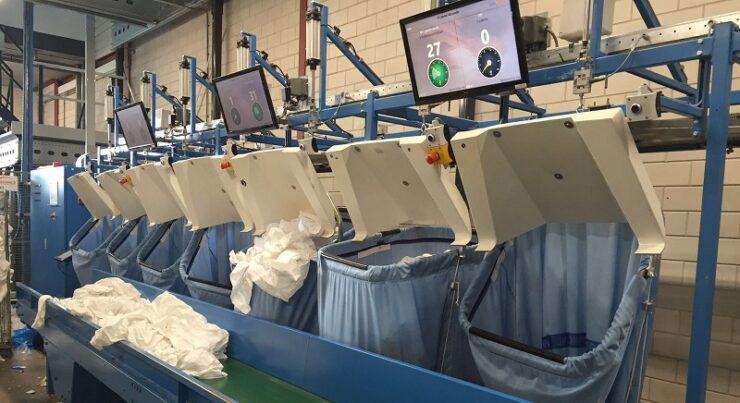
Sorting bags with counting screen in laundry operations
4. Billing Accuracy and Revenue Protection
Billing disputes are a direct margin risk.
When deliveries, returns, losses, and service events are based on manual counts or estimated records, invoice confidence weakens. Customers challenge counts. Credit adjustments accumulate.
Commercial teams lose time defending invoices instead of managing accounts.
RFID supports scan-verified billing by linking each textile asset to a unique identity and recording its movement through the operation.
With properly integrated scan data, billing accuracy can reach the 98–99% range in optimized RFID-enabled workflows. The business value is not only fewer disputes. It is stronger invoice confidence, faster reconciliation, and better evidence during customer reviews.
For customer-facing teams, this changes the conversation. Instead of relying on estimates, the operator can show item-level evidence of what was processed, delivered, returned, lost, repaired, or retired.
In a sector where customer relationships can last years and contract values can be substantial, revenue protection is often one of the most underweighted parts of the RFID ROI case.
5. Customer Profitability Blindness
One of the most strategically important problems in textile rental is the inability to determine, with confidence, which customer accounts are profitable and which are not.
Revenue is visible.
The full cost to serve a specific account is often not.
That cost includes garments allocated, loss rates attributable to that account, route labor, emergency replacements, processing intensity, soil levels, SKU complexity, repairs, rewash rates, and customer-specific service requirements.
Without item-level and account-level data, pricing decisions are often made from revenue data alone.
RFID-generated account data helps close this visibility gap. Every garment movement can be connected to a customer account, making cost-to-serve analysis more practical. That gives operators stronger evidence for contract renewal, pricing adjustments, service-level discussions, and sales targeting.
Reframing the RFID ROI Conversation
The most persistent barrier to RFID adoption is not always technological skepticism. It is the framing of the investment decision.
When the question is posed as:
“Does an RFID tag justify itself against the cost of a garment?”
the answer can appear marginal.
When the question becomes:
“What is the fully loaded operational cost of not having systematic item-level tracking across the full lifecycle of the fleet?”
the calculation changes.
A complete RFID ROI model should account for:
- fleet shrinkage and replacement cost;
- sort, count, and audit labor;
- emergency garment or linen procurement;
- billing disputes and credit adjustments;
- overstocking caused by poor inventory confidence;
- underutilized or stranded inventory;
- premature retirement or delayed retirement;
- account-level profitability loss;
- customer retention and contract risk;
- data readiness for automation and analytics.
When these cost categories are modeled together rather than separately, RFID payback is often evaluated in the 18–24 month range for mid-sized and larger textile operations. This should not be treated as a guaranteed result. It is a planning range that becomes more accurate when operators use their own baseline data for shrinkage, labor, fleet value, billing disputes, and replacement cost.
This is why RFID should be evaluated through lifecycle economics, not only unit cost.
The value is not the chip alone. The value is the operating data created across the full textile lifecycle.
RFID as the Data Layer for AI and Advanced Analytics
Commercial laundry operators are increasingly exploring AI and advanced analytics.
Potential use cases include demand forecasting, predictive replenishment, route optimization, automated quality inspection, customer profitability analysis, and fleet right-sizing.
But every analytics system depends on the quality of the data underneath it.
The question every operator should ask before investing in AI is:
Is the underlying data granular enough, clean enough, and comprehensive enough to support the conclusions this tool will be asked to produce?
In many textile operations, the honest answer is still no.
Granular data means item-level, event-level, and timestamped records. It means knowing not only that a customer received 200 garments this week, but which 200 garments, what their cycle counts were, where they were processed, when they were read, what exceptions occurred, and how they moved across the customer relationship.
RFID creates this data as a byproduct of normal operations.
Each read event at a tunnel, portal, dock door, handheld reader, or other read point adds to the operational record. Over time, this creates a dataset that can support predictive models, better dashboards, and more accurate business decisions.
AI does not create insight from incomplete data. It amplifies the signal in the data it receives.
RFID helps commercial laundries create the item-level signal required for more reliable operational intelligence.
From Cost Control to Data Control
Commercial laundry has always been a business of operational discipline.
Profitability is won or lost in the details: the garment that should have been retired earlier, the item that disappeared between customer and facility, the account that looks profitable on revenue but loses money on service intensity, the billing dispute that damages a long-term relationship, or the hours spent counting what a reader could verify automatically.
RFID addresses these details as operational infrastructure.
It changes what an operator can know, how quickly they can know it, and what decisions they can make with confidence.
This is the wider technology investment case for commercial laundry and textile rental.
The industry is not only buying tags. It is building the data foundation for more measurable operations.
Where Xerafy Fits
Xerafy designs and manufactures RFID tagging solutions for industrial environments where durability, reliability, and application fit matter.
For commercial laundry and textile rental operators, Xerafy’s TEX Series supports item-level identification across garments, linens, uniforms, healthcare textiles, hospitality textiles, and reusable textile assets.
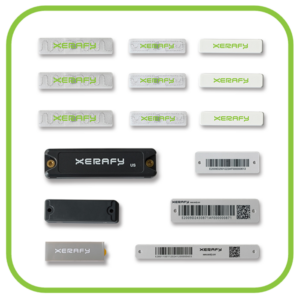
TEX Series RFID laundry tags are designed for demanding textile workflows, including repeated industrial wash cycles, high-temperature processing, chemical exposure, mechanical handling, and textile integration through sewing, heat-sealing, or other application-specific methods.
But the tag is only one part of the value. Xerafy works with operators, system integrators, laundry management platforms, and RFID ecosystem partners to support the data layer behind textile inventory visibility, lifecycle tracking, billing accuracy, account-level reporting, and operational analytics.
The goal is not to add RFID for its own sake. The goal is to make textile operations more measurable, more accountable, and better prepared for the next stage of technology investment.
Is your textile operation ready for item-level data? Talk to Xerafy about RFID data infrastructure for commercial laundry, textile rental, workwear, uniform, linen, healthcare, and hospitality textile operations.

More Resources
- Explore the Xerafy TEX Series for RFID laundry tagging
- Download the Xerafy Guide to RFID Tagging for Textile Inventory
- Read how RFID supports textile lifecycle tracking in real-world applications
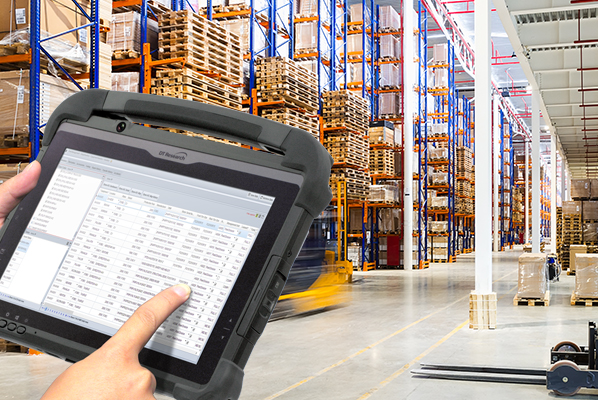
- Learn about RFID readers and warehouse scanners for textile operations
- See Xerafy’s RAIN RFID laundry tag durability validation
About Xerafy
Xerafy specializes in advanced RFID tagging solutions for textile inventory control.
A member of TRSA, NAUMD, and RAIN Alliance, Xerafy delivers cost-effective, field-proven, and customizable RFID tags built for industrial laundry, healthcare, hospitality, and textile rental services.
With engineering-led product design and a commitment to open, scalable systems, Xerafy helps operators reduce losses, automate workflows, and grow without vendor lock-in.