
Email Your Representative
Enterprise-grade RFID laundry tags certified over 200 wash cycles, with high bulk-read performance for high-volume textile operations
TEX TRAK RFID laundry tags are certified for high-volume textile operations where read rates, durability, and availability directly impact throughput and cost.
Designed to perform reliably in dense textile loads and bulk reading scenarios, the TEX TRAK series includes ultra-thin RFID laundry tag formats that are EECC certified over 200+ industrial wash cycles, including high-temperature washing, drying, ironing, and high-pressure dewatering.
With bulk-read performance of up to 10 meters, the series supports automated inventory handling across uniforms, workwear, linens, and garments in industrial laundries, hospitals, service providers, OEM programs, and end-user operations.
TEX TRAK is built for textile lifecycle identification, not just laundry tagging.
The series supports high-volume textile inventory control across owned and rental workflows. RFID tag and chip formats can be selected according to the textile item, workflow, attachment method, read environment, and deployment scale:
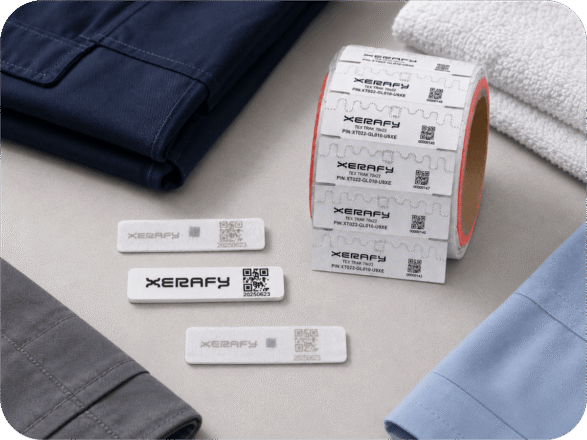
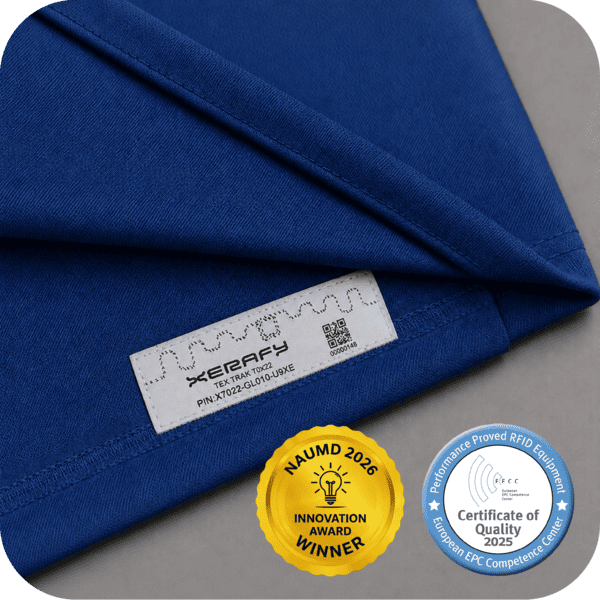
> TEX 70×22 Roll is our award-winning lead format for rental programs where RFID tags need to be printed, encoded, and deployed on demand.
> TEX 70×15 supports uniforms, linens, and garments requiring longer-range performance.
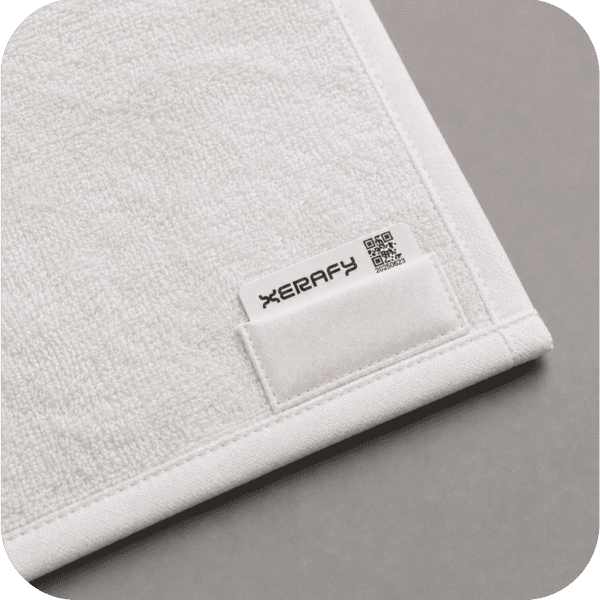
> TEX 50×12 fits smaller textile items such as towels, gowns, and accessories
> TEX 55×12 Silicone is suited for comfort-sensitive garments, offering discreet integration.
Manual laundry tracking is prone to shrinkage, misplacement, and inefficiencies. TEX TRAK enables automated, accurate, and secure inventory management: reducing labor, eliminating errors, and delivering full operational visibility across textile lifecycles.
“RFID tracking reduces textile loss rates from typical 15% levels to under 3%, delivering full traceability and reliable service in high-volume laundry operations.”
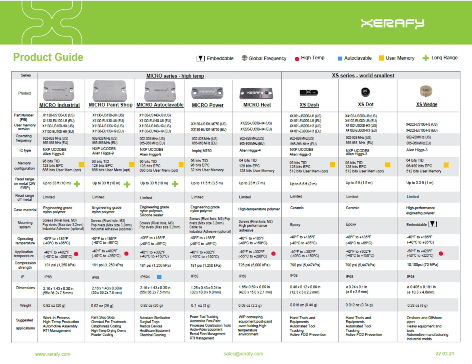
For end-to-end coverage, TEX TRAK can be deployed alongside Xerafy’s broader portfolio: TRAK tags for general inventory, OUT TRAK long range tracking for cages and roll containers, POD TRAK for returnable laundry bins and carts, XPLATE TRAK with stampable customization, and METAL SKIN printable labels for on-metal applications.
The TEX TRAK series is engineered for industrial laundries that demand performance, durability, and seamless integration, across healthcare, hospitality, and textile services.
Certified for real-world industrial laundries over 200+ full cycles without loss of performance: washing, dewatering, drying, ironing, and folding.
Performs reliably under sterilizing heat and pressure, meeting the demands of healthcare and high-throughput laundry environments.
Industry-leading performance enables efficient bulk reading and automation, even in densely packed textile operations.
Attach by heat-sealing, sewing, or insertion for a secure, discreet fit across garments, linens, and uniforms.
Every tag features a unique EPC identifier for accurate tracking across inventory lifecycles and laundry processes.
Support high-volume owned and rental textile programs with item-level visibility across issue, wash, sort, return, repair, and replacement workflows.
TEX TRAK tags are available in multiple formats to match different asset sizes,
read-range requirements, workflows, and application constraints

Print-Ready Roll Format
The TEX 70x22 Roll is a durable UHF RFID laundry tag designed for high-volume textile inventory tracking.
Supplied in roll format for seamless use with industrial RFID printers, it supports on-demand printing and encoding, enabling fast deployment for OEMs, converters, and textile service providers. With a read range of up to 6 meters and endurance certified beyond 200 industrial wash cycles, it performs reliably through washing, sterilization, drying, and pressing.
Medium-Size Fabric Tag
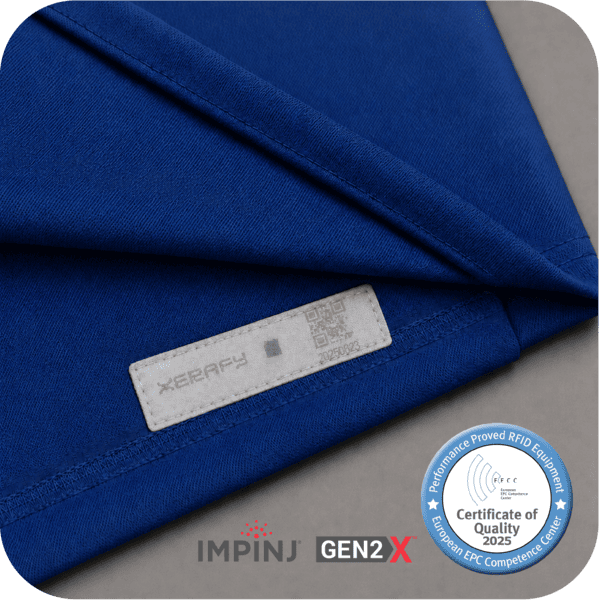
The TEX 70x15 is a washable UHF RFID tag built for textile inventory applications across uniforms, linens, and garments.
It delivers long-range readability up to 10 meters, and is certified to endure 200+ industrial laundry cycles, including high-temperature washing, drying, and sterilizing heat. Its slim form factor enables easy heat-seal or sew-in integration.
Compact Fabric Tag
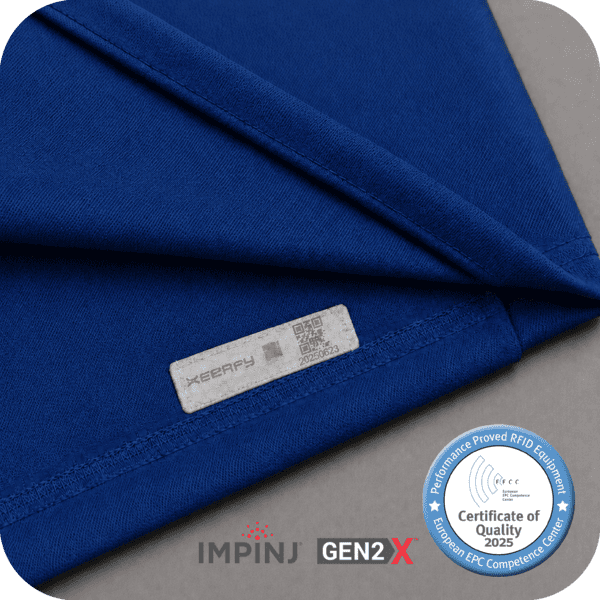
The TEX 50x12 is a small-size UHF RFID tag designed for space-constrained textile items such as towels, gowns, or accessories.
Its low-profile design and 200+ cycle durability certification make it a cost-efficient solution for large-scale laundry operations.
Flexible Silicone Tag
The TEX 55x12 Silicone is a rugged RFID laundry tag housed in a soft, smooth, flexible silicone case for discreet, comfortable integration into garments.
It is IP68-rated and survives over 200 industrial wash cycles, with resistance to high-pressure dewatering, drying, and sterilizing heat. Ideal for healthcare and hospitality where tag comfort and resilience are equally critical.

All TEX TRAK RFID tags are fully customizable to align with your laundry management system, whether for branding, compliance, or item-level tracking.
Compatible with thermal transfer and roll-to-roll RFID printers for on-demand printing of logos, brand names, serial numbers, and more.

Support for permanent laser engraving of barcodes, QR codes, and other visual identifiers—ideal for durability and visual tracking.

Flexible memory encoding options including unique EPCs, serial numbers, and application-specific data to enable secure item-level traceability. Supports continuation of existing serial number series for seamless integration with high-throughput laundry systems.

Custom form factors available on request—dimensions, antenna design, and materials can be engineered to meet unique operational or environmental requirements.
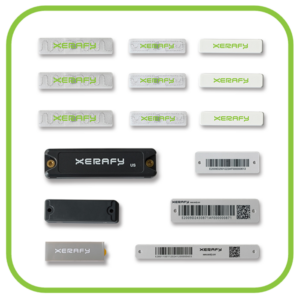
TEX TRAK RFID tags are trusted for the durable identification and automated tracking of textile inventory across owned and rental workflows, helping streamline operations, reduce shrinkage, and ensure compliance.
Yes. Selected TEX TRAK RFID laundry tags are certified by EECC to survive over 200 industrial laundry cycles.
For laundry operators, 200-cycle endurance is often the first qualification gate. Many RFID laundry tags claim long cycle life, but third-party certification gives buyers a stronger basis for comparison before deployment.
TEX TRAK tags are designed to withstand repeated exposure to washing, drying, ironing, pressing, dewatering, sterilizing heat, and common laundry chemicals. For critical deployments, the Xerafy engineering team recommends validating tag performance under the customer’s real laundry process before scaling.
RFID read performance depends on the tag format, textile type, tag placement, reader setup, antenna configuration, item density, and read environment.
TEX TRAK RFID laundry tags are designed for reliable bulk reading in dense textile loads. Depending on the tag format and setup, TEX TRAK can support long-range fixed-reader performance, with up to 10 meters achieved by the TEX 70×15 in suitable configurations.
To improve read rates, operators should validate tag placement, attachment method, reader power, antenna position, tunnel configuration, textile density, batch loading, and read-pass timing. In real laundry operations, read performance should be tested across the full workflow: collection, washing, drying, sorting, packing, storage, delivery, return, and inventory reconciliation.
Operators can also monitor RSSI trends, identify weak or damaged tags early, avoid overloaded batches, and use multiple read passes where required.
For best results, Xerafy recommends validating read range and read rate with a controlled pilot using the customer’s actual textiles, laundry process, read points, and software workflow.
The right TEX TRAK tag depends on the textile type, attachment method, read-range requirement, comfort requirement, and whether the tag needs to be printed or encoded before installation.
TEX 70×22 Roll is designed for print-ready, high-volume workflows where roll format, printing, and encoding are required. TEX 70×15 is a strong general-purpose option for uniforms, linens, and garments. TEX 50×12 is suited to smaller textile items such as towels, gowns, or accessories. TEX 55×12 Silicone is designed for applications where comfort, softness, and flexible integration are important.
Xerafy can help validate the best tag format through a test pack or pilot.
Many RFID laundry tags look similar from the outside. The difference is in certified durability, read performance, attachment reliability, encoding flexibility, and supplier support during qualification.
TEX TRAK is designed as an industrial textile RFID platform, not only as a washable RFID chip. The series includes EECC-certified 200+ cycle formats, high bulk-read performance, heat-seal, sew-on, sew-in, silicone, and print-ready roll options, plus support for printing, marking, encoding, and custom engineering.
When comparing RFID laundry tags, buyers should look beyond tag appearance and unit price. The practical questions are:
> Is the tag certified for industrial laundry cycles?
> Does it continue to read reliably after repeated processing?
> Can it be attached correctly to the textile?
> Can it be encoded and serialized for the workflow?
> Can the supplier support testing before scale-up?
TEX TRAK RFID laundry tags are used to identify and track textile assets at item level across industrial washing, sorting, delivery, return, repair, and replacement workflows.
Common applications include industrial laundry operations, uniform and workwear rental programs, hospital linens, medical scrubs and gowns, hotel linens and towels, branded apparel, and reusable textile assets.
Each tag gives a textile item a unique RFID identity, allowing operators to automate inventory counts, reduce manual handling, improve accountability, and track textile lifecycle data.
RFID laundry tags are usually attached by heat-sealing, sewing onto the textile, sewing into a hem or pouch, or integrating the tag during garment manufacturing.
Heat-seal is often preferred for existing linens and uniforms because it is fast, discreet, cost-effective, and durable.
Sew-on and sew-in methods are useful when flexibility, comfort, concealment, or textile construction requires a different approach.
Placement matters. Tags should normally be positioned along hems, seams, edges, or low-stress areas where they remain readable and protected during washing, drying, folding, and use.
TEX TRAK tags use passive UHF RAIN RFID technology and support item-level identification through unique EPC encoding.
In a laundry workflow, RFID readers can capture tagged textiles at collection, washing, sorting, packing, delivery, return, and inventory checkpoints. The RFID data can then be used by laundry management systems for inventory control, billing, customer reporting, lifecycle tracking, and exception management.
TEX TRAK tags can also support printing, marking, and encoding workflows for operators that need visible identifiers, serialized EPCs, or integration with an existing item numbering structure.
TEX TRAK tags can support printing/marking, encoding, and custom engineering depending on the tag format and deployment requirements.
Printing can add logos, text, serial numbers, or visual identifiers. Marking can support permanent barcodes, QR codes, or human-readable IDs. Encoding can assign unique EPCs, serialized item numbers, or application-specific data for item-level traceability.
For high-volume textile programs, Xerafy can support roll format supply, on-demand printing and encoding, custom dimensions, antenna design, and materials adapted to specific laundry workflows.
RFID laundry tags give each garment, linen, uniform, or reusable textile asset a unique identity. This allows commercial laundries, textile rental operators, uniform rental companies, and workwear service providers to track what was collected, washed, sorted, packed, delivered, returned, repaired, or retired.
This helps reduce shrinkage from lost, misrouted, discarded, or unreturned items. It also reduces manual counting, sorting, audit, and reconciliation work. For rental and service operators, RFID data can support more accurate billing, fewer customer disputes, better lifecycle tracking, and stronger account-level reporting.
The value is not only the tag. The tag identifies the textile item. The RFID system turns that identity into operating data for inventory control, billing accuracy, lifecycle tracking, and customer accountability.
Yes. RFID textile tags can support Digital Product Passport readiness by giving each garment, linen, uniform, or textile item a persistent, machine-readable identity that can connect the physical product to digital product data.
For textile manufacturers, brands, rental operators, and service providers, RFID can support item-level identification, lifecycle tracking, repair, reuse, resale, recycling, and product-as-a-service models. This makes RFID useful not only for laundry operations, but also for circularity, compliance, and long-term textile inventory visibility.
Digital Product Passport requirements are still evolving, especially in the EU. Textile manufacturers should validate the required data structure, identifier format, durability requirements, data carrier, and system integration for their specific market and product category.
Start with one controlled workflow and one textile category, such as towels, uniforms, scrubs, gowns, hotel linens, or workwear.
A practical pilot should define the item type, tag format, attachment method, read points, software workflow, success criteria, and number of laundry cycles to validate. The tagged batch should go through the normal operating process, including washing, drying, sorting, packing, delivery, return, and inventory reconciliation.
Xerafy’s Textile Test Pack and engineering support can help teams compare tag formats, validate read performance, and confirm durability before scaling.